

We oppose the badger cull
The costly badger cull has ended
Devon Wildlife Trust welcomes the Government’s commitment (June 2026) to end the routine culling of badgers and supports the transition to a more effective, evidence-led strategy for controlling bovine tuberculosis (bTB), a highly infectious disease.

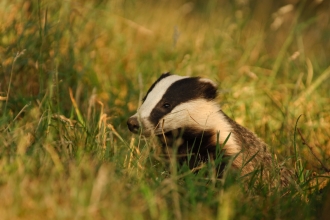
Badger. Photo, Darin Smith
The impact of bovine tuberculosis
Bovine tuberculosis (bTB) is a highly infectious disease of cattle that devastates thousands of farming businesses annually. Since the mid-1980s, the incidence of bTB in cattle has increased substantially, creating an economic burden on taxpayers and the farming industry, as infected cattle must be culled.
UK Government research shows that tuberculosis is not a major cause of death in badgers. Generally, infected badgers do not show any sign of infection and can survive for many years before suffering from severe emaciation.
Devon Wildlife Trust is very conscious of the hardship that bovine TB (bTB) causes in the farming community and the need to find the right mechanisms to control the disease, along with support, funding and advise from Government.
We do not consider widespread badger culling to be an appropriate or necessary tool for the long-term control of bTB. Scientific evidence demonstrates that culling badgers is unlikely to control the disease and may even make the problem worse.
We need our Government to invest in a long-term approach to disease control, with badger vaccination playing a key role.
The cull is scientifically unsound
Robust evidence is still lacking to demonstrate that badger culling is worth the loss of thousands of badgers and millions of pounds of public spending. To justify the badger cull and to try and show that badger culling is having a significant impact on lowering bovine TB in cattle, the previous UK Government regularly used the Downs et al (2019) paper and more recently, the Birch et al (2024) paper. Both papers however noted that they didn't or couldn't take acccount of confounding factors. The latter paper described one of these confounding factors, noting that the study farms involved in the Badger Control Policy were required to implement reasonable biosecurity measures. It went on to conclude that whilst it found a reduction in bovine TB on the study farms, the "vaccination of badgers, fertility control and on farm biosecurity may also achieve this effect".
How we can reduce the impact of bTB?
A cattle-led approach
This is a cattle problem, not a badger problem
Evidence shows that badgers are not the primary cause of the spread of tuberculosis in cattle and that the primary route of infection is from cow-to-cow contact – so a vaccine for cattle should be a government priority.
We support Defra’s strategy which prioritises measures that reduce transmission from hidden infection, risky trading and delays in detection and response. Key actions are:
- Improved testing and earlier detection of infection
- Stronger controls on cattle movements and risk-based trading
- Enhanced on-farm biosecurity
- Accelerating development and deployment of cattle vaccination and DIVA testing
We see cattle vaccination as potentially transformative, but recognise that it is not yet fully deployable and delivery at scale will require sustained investment, systems and farmer confidence.
Targeted, non-lethal wildlife management
We support a complementary and proportionate approach to wildlife, focused on:
- Strategic deployment of badger vaccination
- Practical steps to reduce cattle to wildlife contact where feasible
- Continued surveillance, monitoring and research
Badger vaccination must form part of the future disease control strategy, but it will only succeed if Government provides the sustained, long-term investment required to scale delivery, build capacity, and ensure effective targeting. Without this commitment, there is a significant risk that the transition away from culling will fail to deliver meaningful disease reduction.
Partnership and collaboration
Long-term success will depend on:
- Working constructively with farmers, vets and land managers
- Reducing polarisation and building trust
- Developing solutions that are practical, scalable and widely supported

Credit: Kevin Keatley
Badgers are a valued species in the UK, protected by law
25% of the European population is found in the UK, so we have an international responsibility to conserve them.
What are The Wildlife Trusts doing?
The Wildlife Trusts have been working on the issue of bovine tuberculosis and its links to badgers for several years. During this time our activities have included:
- Undertaking badger vaccination programmes since 2011* on our nature reserves and in the wider countryside in partnership with vets, farmers, and landowners.
- Working with Defra on a Badger Edge Vaccination Scheme. Collating, summarising and presenting the science on the spread of bovine tuberculosis.
- Lobbying the UK Government to drop the failed badger cull policy, implement an all-encompassing badger vaccine strategy and encouraging the advancement of the cattle vaccine.
- Standing up for badgers in local and national media and via supporting and promoting e-petitions to stop the cull.
The Wildlife Trusts welcome the new Government position, whilst stressing that:
- Farmers should be fully supported to tackle cattle-to-cattle transmission, including through more funding and advice.
- There should never be a return to culling. Arguments that wildlife movements make a significant contribution to the disease should be closely scrutinised, as it was this mistaken approach that led to the ecologically disastrous badger cull.
- Badger populations in some parts of England are now in a perilous state and should be supported to recover.
Read more about what The Wildlife Trusts believe to be the solution to tackling bovine tuberculosis, as well as recent blogs and press releases on the issue below:
Does Devon Wildlife Trust vaccinate badgers?
Badger vaccination can help reduce the spread of bovine TB within badger populations. However, it is most effective when carried out consistently over a sufficiently large area as part of a coordinated regional or national programme.
A small, isolated vaccination scheme is unlikely to have a significant impact on bovine TB at population or landscape scale. Vaccination also does not cure badgers that are already infected and must be sustained over several years so that an increasing proportion of the population is protected.
Now that large-scale badger culling has ended in England, we believe Government should lead and adequately resource a strategic, landscape-scale vaccination programme, supported by disease surveillance and monitoring. This must form part of a comprehensive approach to bovine TB that includes improved cattle testing, stronger farm biosecurity, responsible cattle movements and the continued development of cattle vaccination.
Devon Wildlife Trust would therefore consider participating in badger vaccination where it contributes to a properly coordinated and evidence-led programme. We would not undertake a unilateral vaccination project where there is little prospect of achieving meaningful disease-control benefits.
Government culls badgers in 11 new areas this autumn, including Devon
• 69 new places will see up to nearly 68,000 badgers killed
• New cull zone in Devon declared although exact location is not made…
The Wildlife Trusts respond to new badger cull licences
The Wildlife Trusts are disappointed and saddened that the Government has issued new licenses to cull badgers in seven areas of England…
-
Government approves badger culling to 2026 and ignores public consultation
Today the Government announced that it will continue to issue licenses to kill badgers over the next four years. This will put 130,000…


Support our work
The vital work we do for nature depends on the support of people who care about the future of Devon’s wildlife and wild places.